The Cleared Corridor
The road was denied 5-0 — but the city came back with a 20-foot 'waterline corridor' that can never be replanted. Tree roots, they said, would damage the pipe.
The Road Was Denied — Then It Came Back
On October 14, 2025, the ZBA unanimously denied the city’s application for a gated driveway and water line from Teak Drive to the Four Hills Landfill. The vote was 5-0.
Weeks later, the city returned with what they called a reduced application — “just the water line.” But the 20-foot cleared corridor remained.
Why 20 Feet? Why Permanent?
At the November 25, 2025 ZBA hearing, it became clear this wasn’t a temporary construction impact. The city stated the corridor must remain permanently cleared because tree roots would interfere with the buried pipe:
“They’re not letting that regrowth. They said that they cannot let that regrow back because they want to make sure that it’s clear for them to maintain the pipes.” — Resident testimony, ZBA Hearing — Nov 25, 2025 [52:34]
“There would be no more trees planted because the roots would be in the problem of the piping and they so the trees will be just wiped out. It’ll just be some yeah shrubs and… wild flowers maybe.” — Resident testimony, ZBA Hearing — Nov 25, 2025 [1:10:18]
At the February 3, 2026 Conservation Commission meeting, Commissioner McCarthy asked why the corridor needs to be 20 feet wide for a pipe. Brendan Quigley (Gove Environmental Services) clarified that 20 feet is the full work area needed for equipment maneuverability — the actual trench is “about one bucket wide.” The trench will be “backfilled and replanted with low-growth shrubbery, with periodic cutting to prevent tree root interference.”
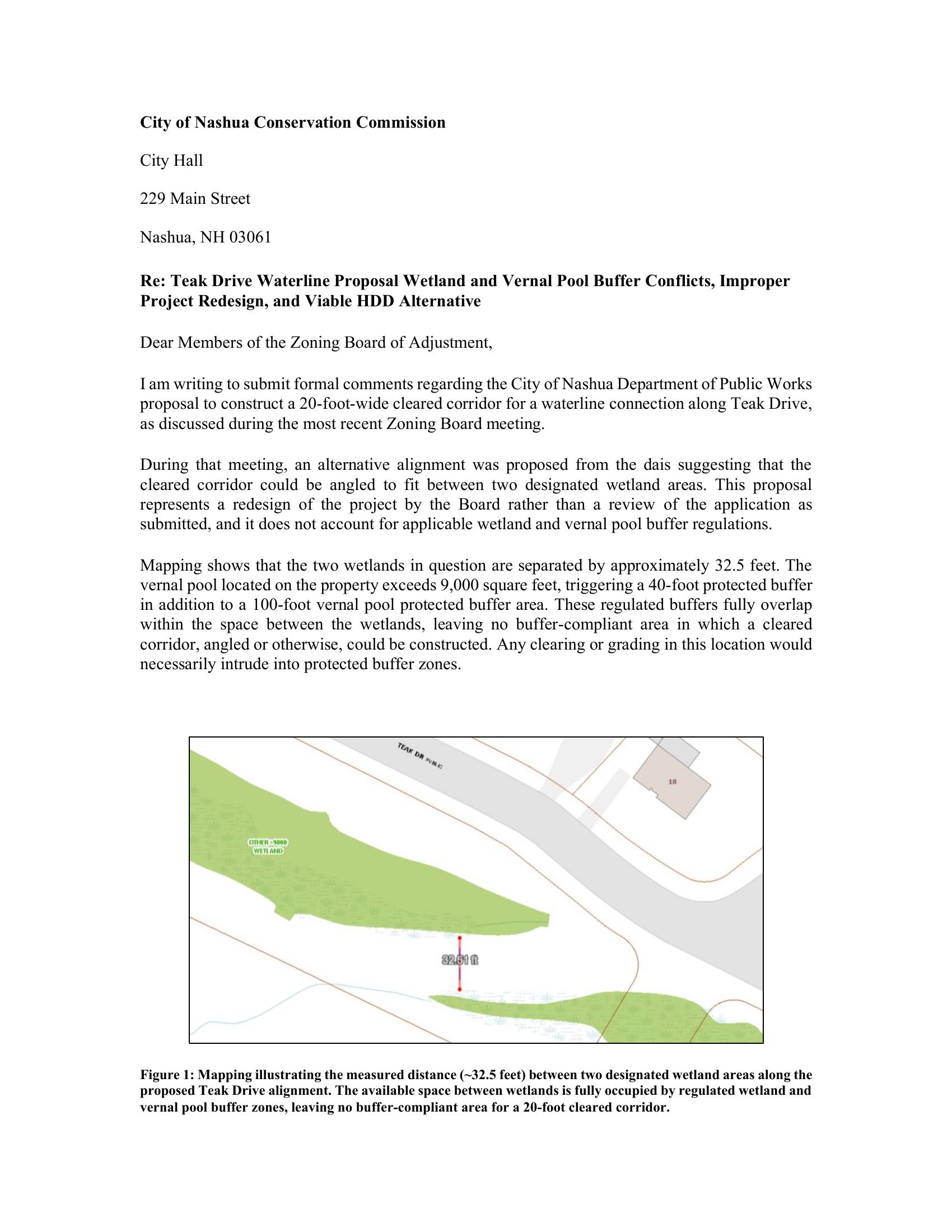
So 20 feet of trees must be cleared to dig a trench that’s one bucket wide — and no trees can ever be replanted because roots would damage the pipe. The 20-foot swath runs approximately 1,200–1,300 feet through a residential neighborhood and wetland buffer.
The Numbers
- Width: 20 feet of permanent clearing (for a trench that’s “about one bucket wide” — per Brendan Quigley, CC Feb 3, 2026)
- Length: approximately 1,200–1,300 feet (city has not fully disclosed the final route — we measured the shortest possible path using GIS)
- Total area: approximately 22,000 square feet of forest permanently removed
- Wetland impact (revised plan): 195 sq ft temporary wetland + 4,727 sq ft temporary buffer (down from 2,545 + 9,533 sq ft in the original road+waterline application)
- Trees lost: 100+ mature trees eliminated (no official tree count done — Quigley confirmed at CC Feb 3: “We haven’t done any additional tree counts”)
- Replanting: Low-growth shrubbery only — no trees, ever (“periodic cutting to prevent tree root interference”)
Deed Restriction on Teak Drive Terminus
At the October 14 ZBA hearing, Alderman Jetty revealed that the land at the end of Teak Drive is deed-restricted as a “non-buildable lot… to be used as drainage retention” [~34:00].
City engineer Dan Hudson offered a contested reinterpretation: the restriction means you “couldn’t put a structure on” it or make it “a buildable house lot” — but he claimed it was “never understood to mean no driveway” [1:37:53]. Hudson also acknowledged the right-of-way is “right smack dab where the vernal pool is” [1:39:22].
Whether a “non-buildable lot to be used as drainage retention” can legally support a road or water line corridor is a question that has not been resolved.
”Phase One of Road Development”
Residents warned that the 20-foot cleared corridor would easily become a road:
“It’s just a water line 20 ft. It’s easy just to increase that and put a road.” — John Collins, ZBA Hearing — Nov 25, 2025 [1:13:41]
The Board’s Own Reasoning Applies Here
On October 14, 2025, the ZBA denied the road application 5-0 on criteria 2 (traffic) and criteria 5 (neighborhood character). The chairman stated: “this is really buried in a residential neighborhood. I can’t get past the degree to which the character of this neighborhood would change irreparably.” (ZBA Hearing — Oct 14, 2025, 2:16:49)
A permanent 20-foot cleared corridor through the same area does the same thing the road would have done — it just does it in stages. Over 100 mature trees permanently removed. Pristine wetland buffers cut through. A 1,200–1,300 foot scar through a residential neighborhood that can never regrow. This is the irreparable character change the board described.
The destruction is unnecessary. An underground alternative (HDD) covers 800–850 feet in a straight line — versus 1,200–1,300 feet of surface trench — at the same or lower cost per foot. Henniker Directional Drilling quoted $250 per foot for 12” HDPE pipe (see the quote), matching the city’s own trench cost. With the city downsizing to 8-inch pipe, HDD would cost even less. The result: zero trees removed, zero wetland impact, zero permanent clearing.
The wetlands and vernal pools in this corridor support state-listed endangered species — Eastern Box Turtle, Eastern Hognose Snake, and fairy shrimp (NHB DataCheck NHB25-0677). The city’s own consultant, Brendan Quigley of Gove Environmental Services, described the property as “highest rank habitat in the region” at the October 14 ZBA hearing. These are pristine protected resources being sacrificed when a zero-impact underground alternative exists at the same price. Even Commissioner Sarno made his Conservation Commission vote contingent on a vernal pool conservation easement — which Attorney Prolman admitted has not been drafted (CC Minutes, Feb 3, 2026).
The Underground Alternative
A Horizontal Directional Drilling (HDD) alternative was formally submitted to the Conservation Commission in February 2026:
- Route: 800–850 feet long, drilled underground (vs. the city’s 1,200–1,300 foot surface trench)
- Trees removed: Zero
- Wetland impact: Zero
- Cost: Equal or lower per foot
- Contractor: Henniker Directional Drilling — the same company the city used to drill a pump force main under the Nashua River
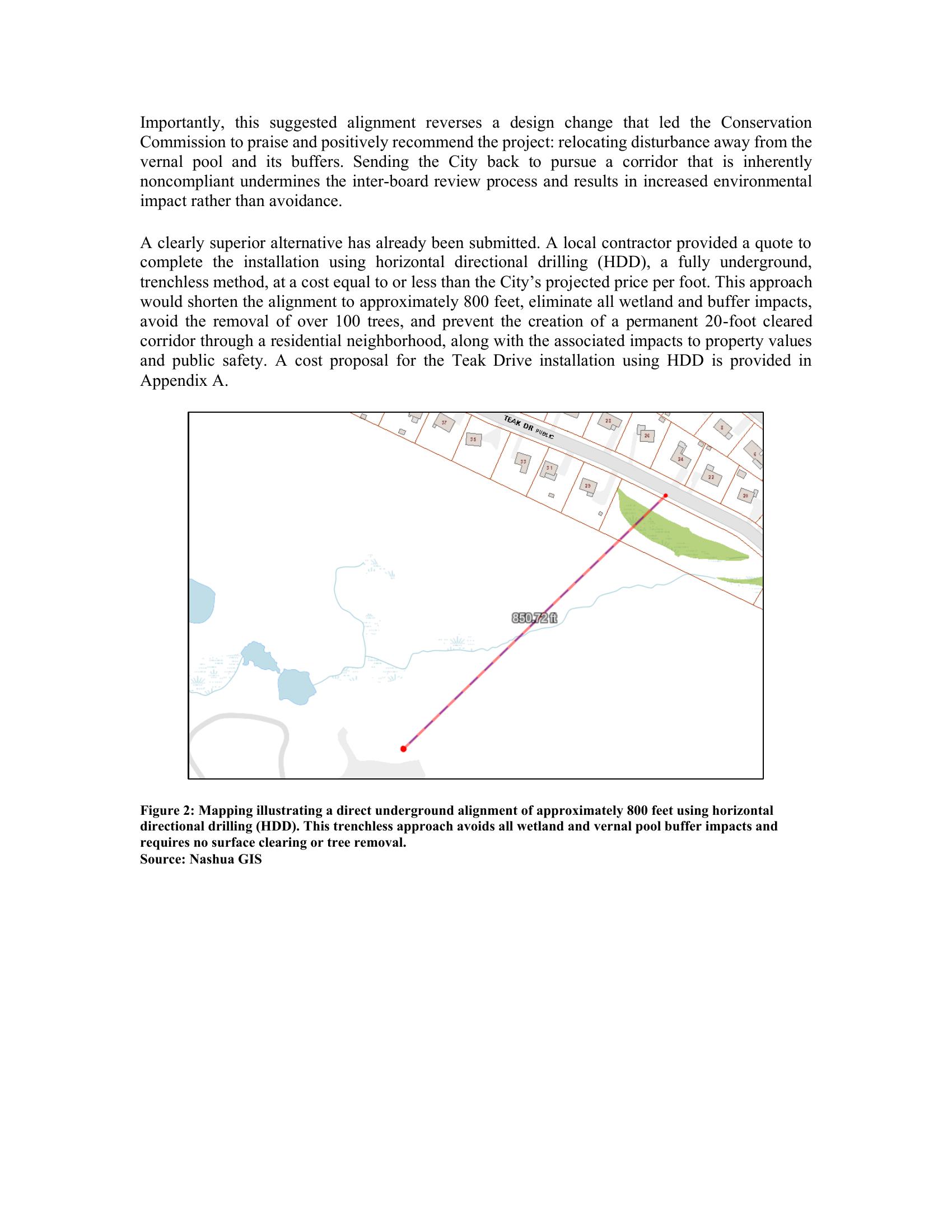
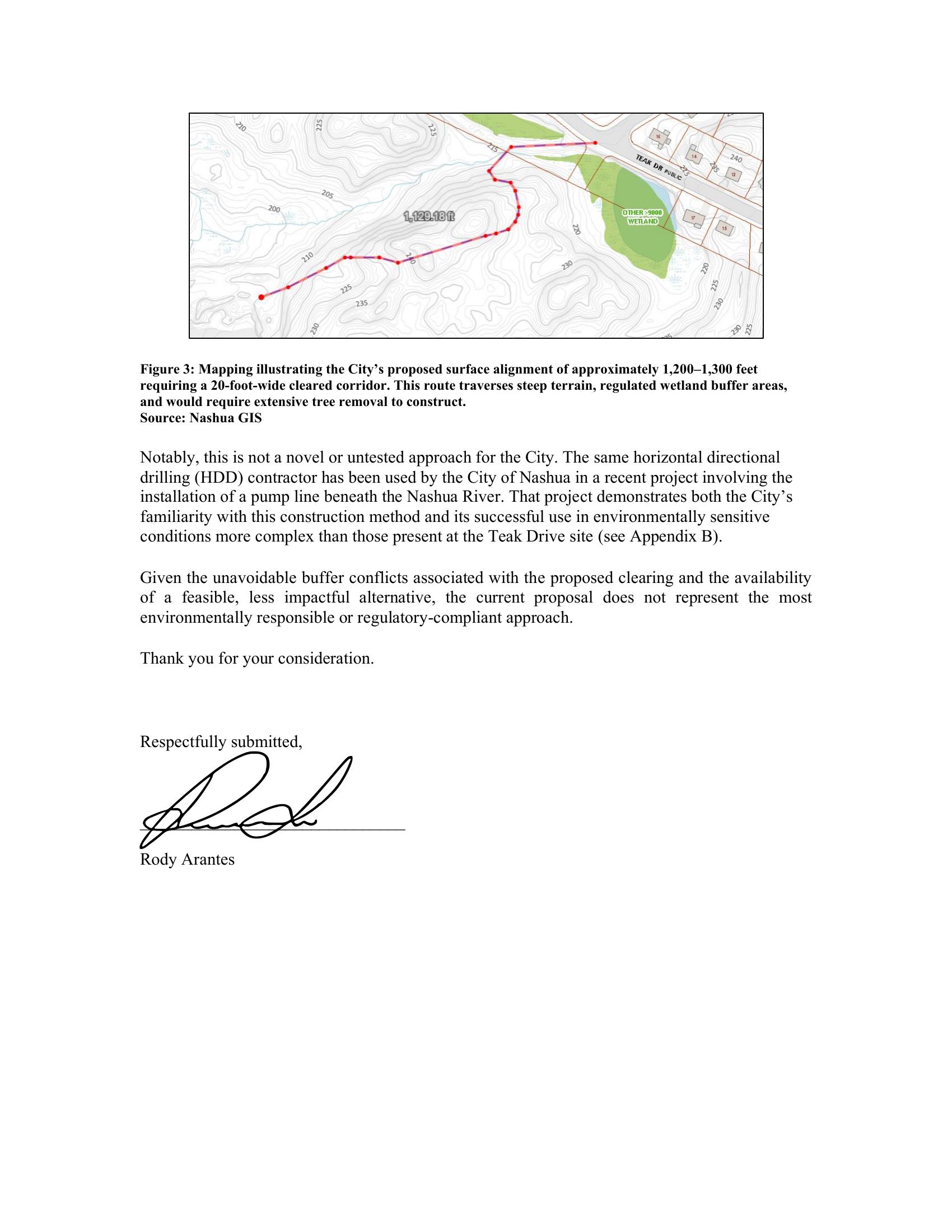
At the February 3, 2026 Conservation Commission meeting, Rody Arantes told the commission the neighborhood would be fully satisfied with HDD even if it only covered the first 500 feet — just enough to get past the trees visible from the street. After that point, there are virtually no trees left to remove anyway. The city could do the full 800–850 feet or just the first 500, but the price per linear foot is the same — so why not run the whole thing underground with the same pipe?
How the City “Evaluated” HDD
The ZBA had told Attorney Prolman to look into HDD as an alternative. He was given a full month. Instead of getting an actual quote or engineering assessment, Prolman reported at the February 3 Conservation Commission meeting that he had asked city engineer Dan Hudson, who said Henniker Drilling quoted “$150–$600 per foot depending on whether ledge is encountered.” Prolman added that the city’s engineering team deemed HDD “unwarranted due to cost concerns and potential issues with pipe maintenance.”
But residents already had an actual quote from Henniker Directional Drilling — the same HDD contractor the city itself has used — at $250 per foot for 12” HDPE pipe, a price per linear foot that matches the city’s own cost for the surface trench. And with the city downsizing to an 8-inch pipe, the HDD cost would be even lower. The city’s wide cost range ($150–$600/ft) was designed to make HDD sound risky — but their own low end ($150/ft) is actually cheaper than the residents’ quote.
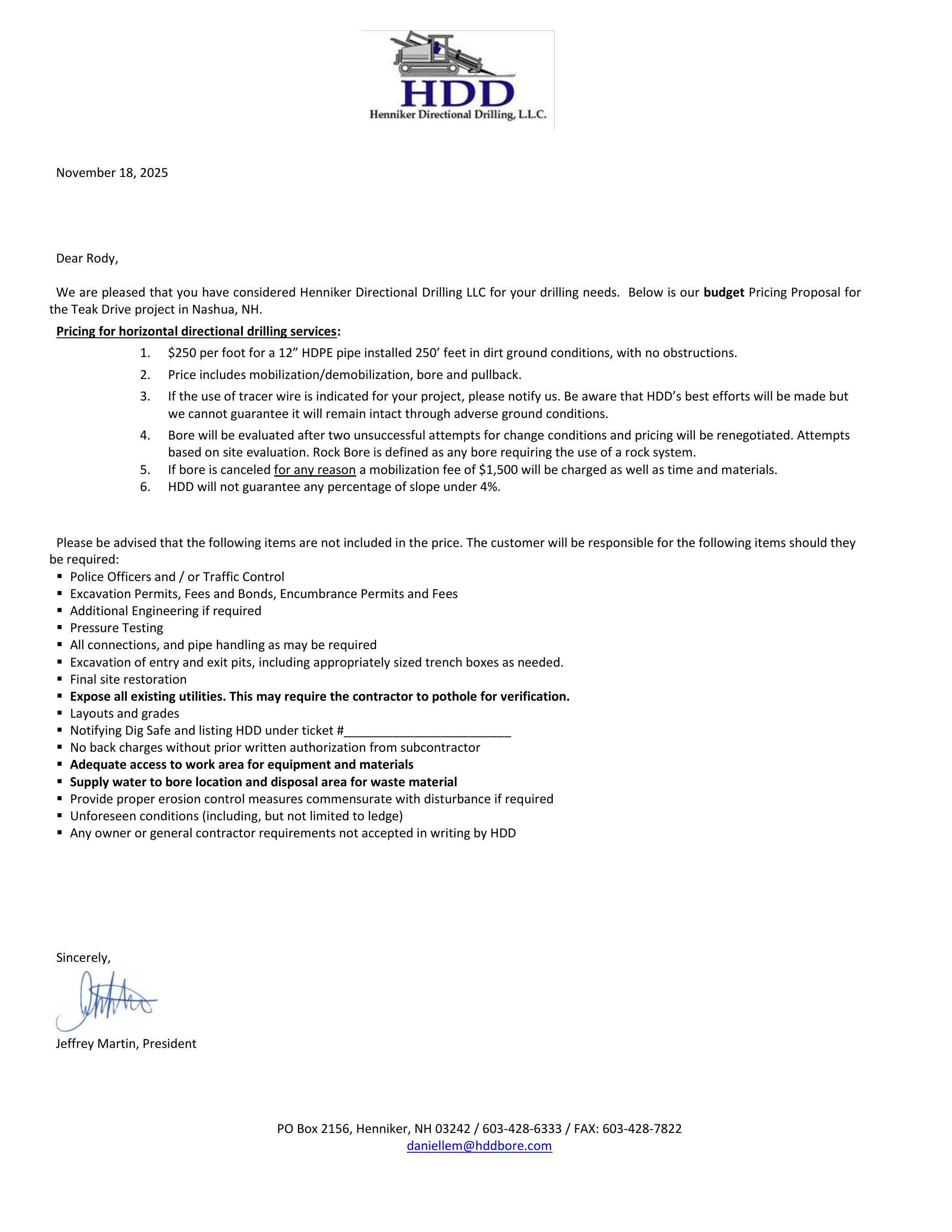
Download the original Henniker quote (PDF)
The Conservation Commission voted 6-0 to approve the city’s conventional trenching plan — and dismissed the HDD alternative without serious consideration. When the topic of directional drilling came up, Attorney Prolman told the commission:
“If we did directional boring, they would find another reason to object. I don’t believe this at all.”
This was said moments after Rody Arantes offered a compromise: HDD for just the first 500 feet. Commission Chair Dutzy added: “No matter what the city does the residents are not going to be happy… you do not want this anywhere near you.”
Even after the 6-0 vote, the commission discussed re-visiting horizontal drilling — suggesting the issue is not settled.
HDD vs. Conventional Trenching
| Conventional (City's Plan) | HDD (Resident Proposal) | |
|---|---|---|
| Method | Open trench — dig, lay pipe, backfill | Drill underground — no surface disruption |
| Route length | 1,200–1,300 ft surface (shortest GIS path — full route not disclosed) ZBA hearing ↗ | 800–850 ft (straight line) see route maps ↗ |
| Trees removed | 100+ mature trees survey docs ↗ | Zero |
| Wetland impact | Cuts through 2 wetlands + vernal pool buffer wetlands page ↗ | Zero — passes underneath |
| Permanent clearing | 20-ft corridor — no trees ever replanted CC minutes, Feb 3 ↗ | None — surface untouched |
| Pipe material | Not disclosed — typically Ductile Iron (50–75 yr lifespan) | HDPE — 100+ year lifespan, no corrosion see chart ↗ |
| Joints / leak points | Multiple mechanical joints | Zero — heat-fused continuous pipe |
| Repair if needed | Dig up the corridor | Trenchless — CIPP, QuickLock, or coating see methods ↗ |
| Cost per foot | City's own trench cost | Equal or lower Henniker quote (PDF) ↗ |
| Contractor | City DPW (self-install) | Henniker Directional Drilling |
| City experience | Standard | Same contractor drilled under the Nashua River for the City |
| City engineering study | Full plans submitted | None requested — dismissed without evaluation |
See How HDD Is Actually Installed
How HDD Is Installed
No trenching, no tree removal, no permanent cleared corridor.
How the City Evaluated It
Residents had a real quote from Henniker at the same price per foot.
Why HDPE Pipe Lasts Longer
HDD installs HDPE (High-Density Polyethylene) pipe — the same material used in modern municipal water systems. Unlike metal or concrete, HDPE doesn’t corrode, rust, or crack. It’s heat-fused with zero joints, eliminating leak points entirely.
Estimated pipe lifespan by material
most common
✓ No corrosion, no rust, no joints ✓ Heat-fused connections — zero leak points ✓ Flexible — resists ground movement
Sources: US Fusion, Rangeline Group, Pipe Spy
”But what if you need to repair it?”
Modern trenchless repair methods fix underground pipes without digging — in hours, not days, at a fraction of the cost of traditional excavation.
🔧 CIPP Lining
A resin-coated liner is inserted into the pipe and cured in place — sealing cracks, leaks, and root intrusion. Adds 50 years of life. No excavation.
🔩 QuickLock Repair
A stainless steel sleeve is positioned at the damage site and mechanically locked in place. No cure time, works in live water flow. 50-year lifespan.
🛡️ Internal Coating
Epoxy is sprayed inside the pipe to seal all leaks permanently. Creates a smooth, seamless surface. Completed in hours, not days.
All three methods require only small access points — no trenching, no tree removal. Source: WR Environmental — Trenchless Pipe Repair
What Needs to Happen
- Acknowledge the corridor is permanent — stop describing it as a temporary construction impact
- Seriously evaluate the HDD alternative — it eliminates every tree, wetland, and buffer impact
- Assess cumulative impacts — the DPW garage expansion is a separate project that is displacing the fire training facility to a new location adjacent to Teak Drive, yet no board has reviewed the cumulative environmental impact of the fire training relocation
- Protect the neighborhood character — the same reason the ZBA denied the road applies to a permanent cleared corridor
Source Documents
- ZBA Hearing — Nov 25, 2025 [52:32–53:04] — permanent clearing / tree roots testimony
- ZBA Hearing — Nov 25, 2025 [1:10:13–1:10:25] — no replanting allowed testimony
- ZBA Hearing — Nov 25, 2025 [1:13:41] — John Collins “phase one of road development”
- ZBA Hearing — Oct 14, 2025 [~34:00] — Alderman Jetty on deed restriction
- Conservation Commission Wetlands Application (PDF) — Gove Environmental Services, May 2025
- Henniker Directional Drilling Quote (PDF) — $250/ft for 12” HDPE, Nov 18, 2025
- HDD Alternative Submission (PDF) — Formal submission to Conservation Commission, Feb 2026
- Conservation Commission Minutes — Feb 3, 2026: 6-0 approval of conventional plan, Prolman “they would find another reason to object,” Quigley “marginal habitat,” 195 sq ft wetland + 4,727 buffer, post-vote HDD discussion
- US Fusion — HDPE Pipe Lifespan — 100+ year lifespan data
- WR Environmental — Trenchless Pipe Repair — CIPP, QuickLock, Internal Coating methods